Punching the Core: What Storm Chasing Taught Me About Relationships
There’s a moment when you’re chasing a tornado when everything in your body says turn around, and most people treat their relationships the exact same way. The sky shifts to that unnatural green, the air gets heavy, and the wind starts moving in ways that don’t feel right, and every instinct is telling you you’re getting too close, and if you’re doing it right, that’s exactly when you keep going.
Storm chasers call it “punching the core,” driving straight into the storm, sometimes through the eye itself, not because it’s safe, but because it’s the only way to understand what’s actually happening and to warn others about what’s coming.

Relationships aren’t all that different, because most people spend their time skirting the edges of the storm, avoiding hard conversations, softening the truth, and hoping things will stabilize on their own. They want connection without disruption, clarity without discomfort, and intimacy without risk, and it sounds reasonable until you realize it doesn’t actually work.
If you want a relationship that actually holds under pressure, you don’t avoid the storm, you learn how to move through it.
The Storm Most People Are Already In
When people come to me for coaching, they usually think they have a specific issue, something they can point to and fix. What they’re actually dealing with is a system under stress, and it shows up in familiar ways:
- Communication that goes in circles or escalates quickly
- Needs and expectations that don’t line up, and power struggles that exist even when no one names them
- Trust feels fragile or has already been broken, emotional reactions take over under pressure, and intimacy starts to fade into something that feels more like coexisting than connecting.
- Boundaries are either too loose or too rigid, desire doesn’t match, and life stress quietly bleeds into everything until the relationship is carrying more weight than it can handle.
Somewhere in all of that, people start to lose themselves, either individually or as a couple, and they don’t always notice when it happens.
Even in the first week, I started seeing things more clearly… he gets strictly down to business… grounded, consent-centered, and gave me the clarity to walk away from an unhealthy dynamic.— Coaching client
Most relationships don’t fail because people don’t care, they fail because no one is actually leading the structure of the relationship.
Most people treat these like separate problems, but they’re not, they’re different expressions of the same underlying issue: a lack of clarity, structure, and intentional leadership inside the relationship.
What Happens When You Add Power to the Equation
In D/s dynamics, you don’t get to pretend power isn’t there, you name it, you negotiate it, and you take responsibility for it, and that alone changes everything.
The same struggles don’t disappear, but they do become sharper and more visible, and a lot harder to ignore. Communication has to be precise instead of implied, and mismatched needs stop being inconvenient and start breaking the structure of the dynamic.
Trust becomes foundational instead of optional, emotional regulation becomes a matter of safety instead of preference, and boundaries shift from being suggestions into something that actually holds the entire dynamic together.
A well-held D/s dynamic brings clarity, direction, and intentionality into a relationship, and a poorly held one accelerates dysfunction in ways that are hard to miss. It either becomes a structure that holds you, or a spotlight that exposes exactly where things are weak.
Everything felt intentional, respectful, and rooted in real structure and integrity.— Coaching client
Why Most People Stay on the Edge of the Storm
Most people haven’t been taught how to move through intensity, so they stay on the edges where things feel more manageable, even if they’re not actually improving.
They don’t know how to communicate clearly under pressure, and they haven’t learned how to work with power in a conscious way, so it either gets avoided or expressed sideways. Emotional regulation tends to disappear right when it’s needed most, and structure gets replaced with hope and chemistry, and people act surprised when neither holds under pressure.
So they have the same conversations over and over, they feel the same tension on repeat, and they slowly normalize a relationship that never quite feels steady. It can look functional from the outside, but inside it’s exhausting in a way that’s hard to explain.
The Work: Driving Through, Not Around
My coaching is built around a simple principle that storm chasing taught me early on, you don’t understand the system by avoiding it, you understand it by moving directly through it, with awareness, structure, and the ability to stay steady when things intensify.
That’s what we do together, and it’s not always comfortable, but it is effective.
How the Work Addresses What’s Actually Happening
The Clarity Session is the diagnostic, where we identify what’s actually breaking down and what needs to happen next.

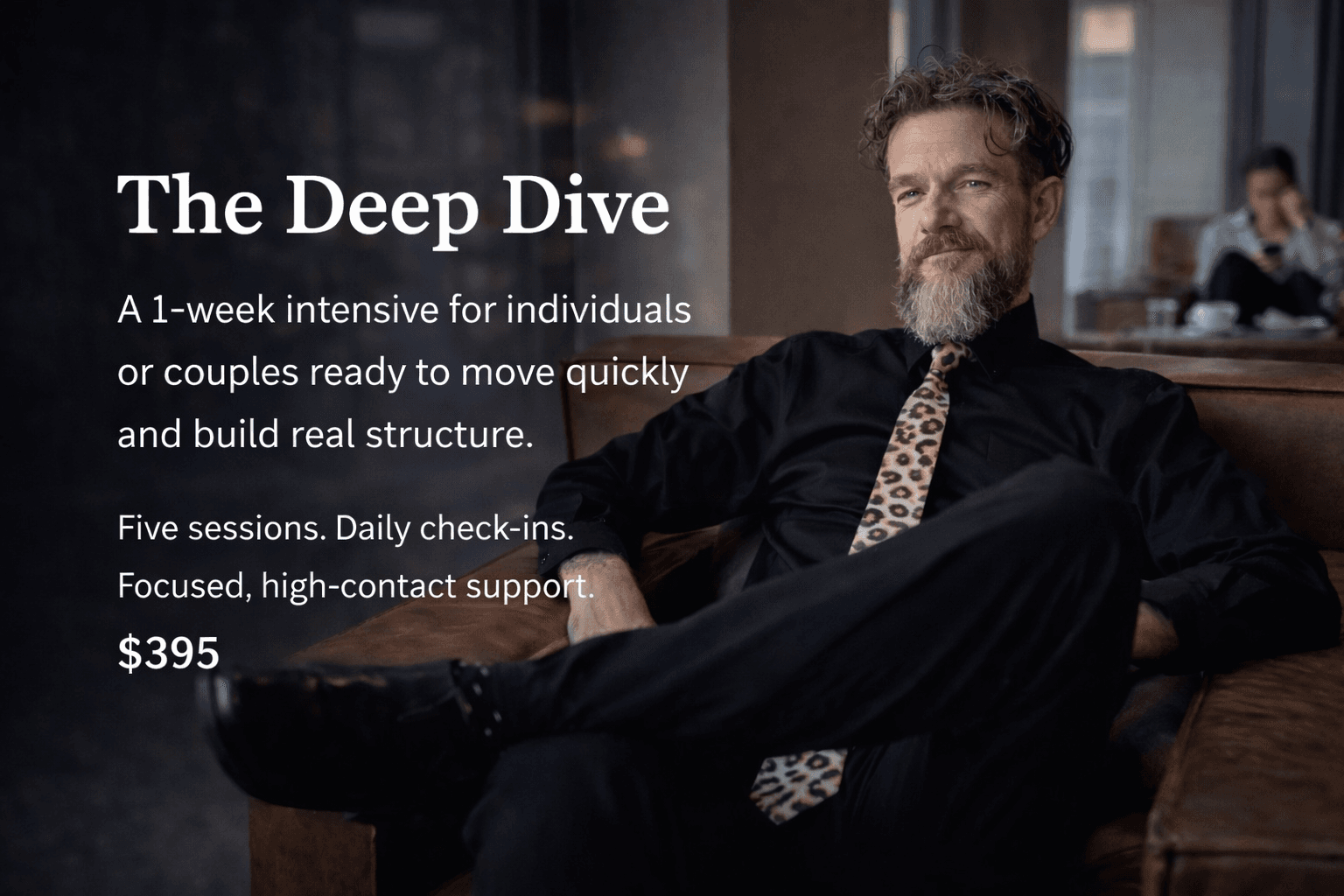
The Deep Dive is the pressure test, designed for people who want movement instead of theory, and over the course of a week we focus on the core issues, apply structure in real time, and see what actually holds when things get uncomfortable.
The Foundation is the rebuild, and this is where real change happens, because over 12 weeks we install communication patterns that don’t collapse under stress, define roles and expectations clearly, and establish consistent check-ins and accountability. Emotional regulation becomes something you can actually access in real time, boundaries become clear and respected, and the relationship develops a structure that holds even when life doesn’t cooperate.

Daily check-ins helped me work with my patterns in real time… I felt safe bringing my most embarrassing and shameful thoughts… I was able to maintain my integrity and have one of the best nights of my life.— Coaching client
This isn’t about fixing one isolated issue, it’s about reorganizing the relationship so the same problems stop repeating.
What’s on the Other Side of the Storm
When you punch the core, you don’t just survive it, you come out the other side with a completely different perspective, and the chaos starts to make sense in a way it didn’t before.
Patterns become visible, intensity becomes something you can navigate instead of something that overwhelms you, and the relationship starts to feel grounded even when things are hard.
The Truth Most People Avoid
You don’t need another surface-level conversation about your relationship, you need structure, clarity, and a way to stay connected when things get uncomfortable.
You need someone willing to go into the storm with you instead of helping you avoid it, because the storm itself isn’t the problem.
Not knowing how to move through it is.
Thoughtful exercises helped me gain clarity on what I actually deserve.— Coaching client
If something in your dynamic feels off, get clear on it, because confusion doesn’t fix itself.